

Cancer and Oncology
Translational Plasma Research
Cancer cells have altered metabolism and reduced tolerance to oxidative stress. JivaJet is advancing cold atmospheric plasma CAP to study targeted biological interactions across in vitro preclinical and early clinical settings.
Research Focus
• Cancer cell line studies and glioblastoma models
• Apoptosis and stress signaling
• Tumor surface and microenvironment interactions
Clinical Context
Early human studies focus on safety and mechanism. CAP remains investigational and is not a standalone treatment.
Rare Genetic Disorders NF1 and TSC
Early Clinical Research
NF1 and TSC involve abnormal cell growth with limited localized options. JivaJet is evaluating CAP as a localized bio interaction modality.
Research Focus
• In vitro and preclinical studies
• First in human feasibility
• Plasma tissue interaction and safety
Clinical Context
Not FDA approved. Further trials required.
Mechanism
Cold plasma generates reactive species that selectively induce stress in diseased cells while sparing healthy tissue. CAP acts as a localized controllable bio interaction platform.
Areas of Investigation
• Adjunct oncology applications
• Tumor surface and margin models
• Apoptosis pathways
• Combination therapies

Anti Microbial Resistance and Multi Drug Resistance
Plasma Based Antimicrobial Research
Antimicrobial resistance and multidrug resistant infections are outpacing antibiotic development, driven by biofilms and reduced drug susceptibility.
JivaJet is advancing cold atmospheric plasma CAP as a non antibiotic modality enabling localized microbial inactivation through physical and chemical interactions.
Research Focus
• In vitro validation against drug resistant organisms
• Biofilm disruption at the surface level
• Microbial membrane and DNA damage analysis
• Resistance agnostic antimicrobial mechanisms
Plasma generated reactive species act through multi target pathways, reducing the likelihood of resistance.
Translational Context
Plasma technologies are being evaluated as complementary infection control strategies and are not FDA approved for clinical use.
Clinical Context
Resistant infections such as MRSA increasingly require surgical intervention. Plasma offers a localized non antibiotic approach for surface level infection control.
Rising resistance in pathogens like MRSA and Acinetobacter baumannii continues to challenge treatment. Plasma enables targeted action without systemic exposure.
Recurring infections in humans and animals are often driven by biofilms. Plasma based approaches provide a non invasive outpatient option that supports infection control while preserving surrounding tissue.

Wound Healing
Plasma-Assisted Tissue Response and Regeneration Research
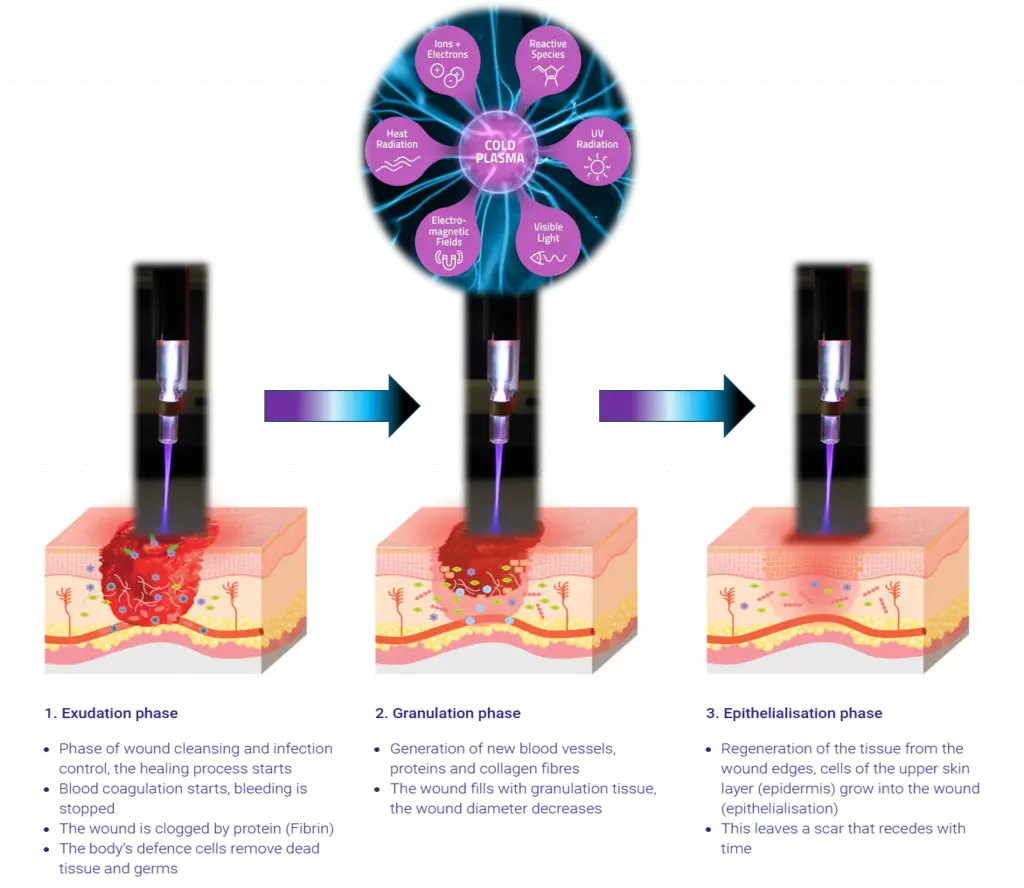
Chronic and non-healing wounds are often driven by a combination of microbial burden, impaired cellular signaling, and reduced tissue regeneration capacity. These wounds frequently fail to respond to standard care, resulting in prolonged healing times and increased complication risk.
JivaJet investigates cold atmospheric plasma as a localized, non-invasive research platform to study how controlled plasma exposure influences wound environments and tissue response.
Research Progress
Plasma wound-healing research includes:
• Pre-clinical animal models evaluating wound closure dynamics
• Plasma effects on fibroblast migration and proliferation
• Reduction of microbial load at wound surfaces
• Investigation of oxygenation and signaling pathways involved in tissue repair
Plasma enables surface-level biological interaction without thermal damage or chemical exposure.
Clinical Context
Wound-healing applications of plasma are under translational investigation and are not approved clinical therapies. Research focuses on biological response, safety, and feasibility rather than clinical outcomes.
Chronic wounds like diabetic ulcers affect millions and often fail to heal with standard of care.
Conditions such as diabetic ulcers and pressure sores often fail to heal with standard care.
Cold plasma supports rapid re-epithelialization and reduce recovery times.
Decontamination and Sterilization
Plasma Based Decontamination
Cold atmospheric plasma CAP enables rapid chemical free decontamination by generating reactive species at ambient temperatures that disrupt microbial membranes proteins and genetic material without damaging underlying surfaces.
Unlike traditional methods that rely on heat chemicals or long exposure times plasma provides localized and efficient inactivation suitable for sensitive environments.
Use Cases
• Medical equipment and device surfaces
• Hospital rooms and high touch areas
• Laboratory and biosafety environments
• Emergency response and field operations
• Spaceflight and planetary protection
Plasma is particularly effective where chemical residues moisture or heat exposure are not acceptable. It does not clean surfaces but inactivates biological threats at the molecular level.
Context
Healthcare and research environments face increasing challenges from resistant organisms biofilms chemical toxicity and slow sterilization cycles. Plasma offers a complementary approach that reduces reliance on chemicals while improving speed and safety.